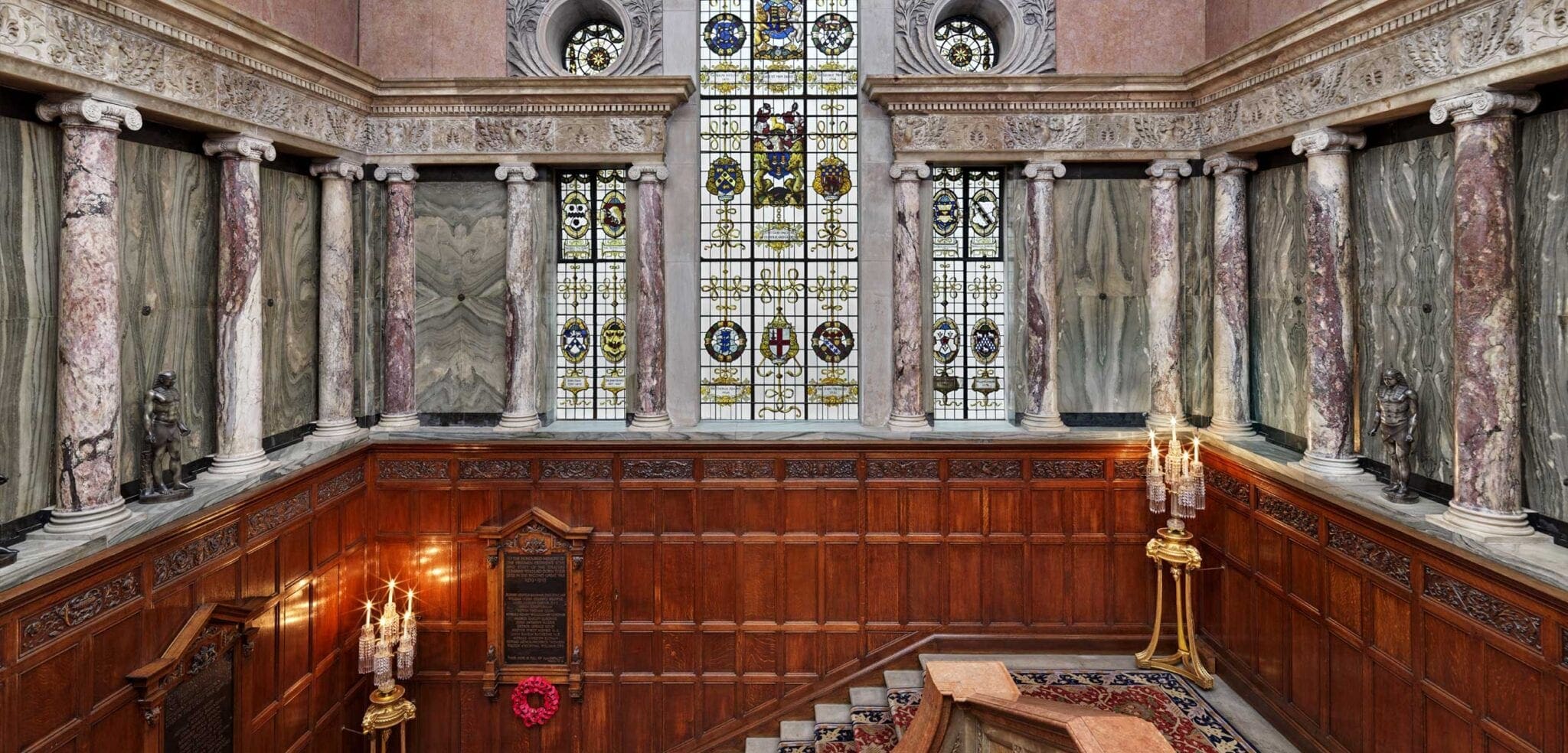
Sir Multon Lambarde (1584-1634)Sir Multon was the son of William Lambarde (1536-1601)English School, early 17th centuryWilliam Lambarde (1536-1601)William, the 16th century historian, entrusted the Drapers with the governorship of Queen Elizabeth’s College, GreenwichEnglish School, early 17th centuryOak benchesCirca 1670Jane Lambarde (1593-1673)Jane was the wife of Sir Multon Lambarde (1584-1634) and daughter of Sir Thomas Lowe, Lord Mayor of London 1604-1605Attributed to Gilbert Jackson, circa 1614Henry Lucas elm chestThis wooden chest came from Henry Lucas Hospital, an almshouse charity in Wokingham of which the Company formerly was trustee. In 2002, the charity was merged with the Whiteley Homes Trust in Surrey17th centuryCloak An early 17th century cloak of deep claret velvet edged with silver and gold bobbin lace spangled with silver dipped mica sequins and bordered in pink cotton plush. Circa 1620The staircase windowThe staircase window contains the royal coat of arms and those of the City, the Drapers’ Company and early Drapers and benefactors; it was renewed after damage during the Second World War.A pair of gilt-bronze and cut-glass candelabraStanding on George III giltwood torchèresJohn Blades, 1810the lover of the Emperor HadrianFrom a portrait by Sir David Wilkie in Windsor Castle. Commissioned by the Company in 1911Isabella Paynter (1646-1677) with her three childrenCommissioned by the Company in 1826Attribute to Edward Bower, 1633William Paynter (1622-1679)William was the husband of Isabella (1646-1677) and is depicted as a member of King Charles I's bodyguard then known as His Majesty's Body Guard of the Gentlemen PensionersAttributed to Cornelius Johnson, 1633Portrait of Thomas Lambarde (1615-1675)Thomas was the son of Sir Multon and Jane LambardeDutch School, circa 1650
The History of
The Entrance Hall
Our main entrance in Throgmorton Street, designed by Sir Thomas G Jackson RA, is guarded by colossal male figures by Henry Pegram and secured by imposing bronze doors.
Inside, the oak-panelled corridor is lit by a stained-glass window containing the coats of arms of four celebrated naval leaders associated with the Company. Sir Francis Drake, Nelson and St. Vincent were each presented with the Freedom of the Company in recognition of their leadership in battle. Sir Walter Raleigh is there because the Company subscribed to the Virginia Company and his exploratory voyages to Virginia.
Along the corridor are portraits of members of the Lambarde family. Their connection with the Company is through William Lambarde (son of John Lambarde, Master in 1547) who founded Queen Elizabeth’s College in Greenwich, almshouses which he entrusted to the Company. A beautiful early 17th century velvet cloak is displayed alongside a portrait of Jane Lambarde wearing the very same cloak. The portraits and cloak, together with a collection of valuable documents and books, were bequeathed to the Company in the 1970s by one of William’s last direct descendants.
Lining the corridor are a set of late 17th century oak benches and iron strong boxes dated circa 1600. An elm wooden box (adjacent to the stained-glass window) came from Henry Lucas Hospital, an almshouse charity in Wokingham of which the Company was trustee until 2002 when it merged with the Whiteley Homes Trust in Surrey.
In the Reception area is a portrait of Henry Fitzalwyn, first Mayor of London, copies of Hans Holbein portraits of Thomas Cromwell (who owned the mansion that stood on this site) and Henry VIII (who took it from him), and a set of prints entitled The Idle and Industrious Apprentices by William Hogarth.